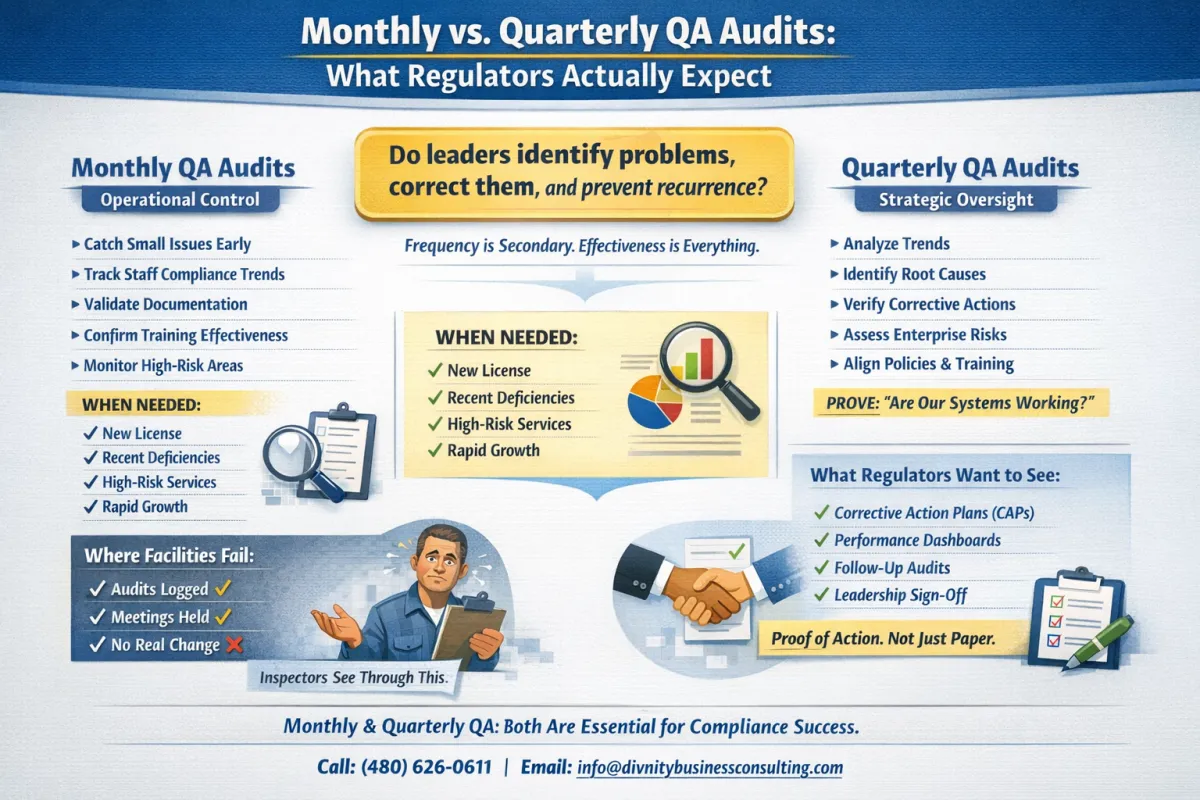
Monthly vs. Quarterly QA Audits: What Regulators Actually Expect
Here’s the quiet truth most owners don’t hear until it becomes expensive: regulators don’t care how often you say you audit. They care whether your QA system proves you’re in control.
Monthly. Quarterly. One-time. None of those words matter without structure, evidence, and follow-through.
As we move through 2026, the era of checklist compliance is over. Regulators and accreditors are no longer verifying whether a policy exists—they’re evaluating whether leadership and staff demonstrate that policy consistently in real operations.
Let’s break this down clearly—no fluff, no fear tactics.
The Question Regulators Are Really Asking
When surveyors, monitors, or funders review your QA program, they are evaluating one core issue:
“Does leadership consistently identify problems, correct them, and prevent recurrence?”
Frequency is secondary. Effectiveness is everything.
The Office of Inspector General (OIG) is explicit: an effective compliance program must not only define standards but also respond appropriately to detected issues and implement corrective action. Surveyors are looking for operational reliability—proof your systems work across all shifts, staff, and service lines, not just on paper.
What Monthly QA Audits Are Meant For
Monthly audits are operational control tools. They function as the pulse check of your organization.
They are designed to:
Catch small issues before they become citations
Identify staff compliance trends (med errors, falls, incidents)
Validate documentation accuracy before records are finalized
Confirm training is being applied—not just attended
Demonstrate active leadership oversight of high-risk areas
Regulators expect monthly QA when:
You are newly licensed
You’ve had recent deficiencies or enforcement actions
You operate high-risk services (behavioral health, DDD, ALF)
You are expanding rapidly
You’ve experienced staff turnover
Monthly QA communicates one message:
“Leadership is actively watching this operation.”
What Quarterly QA Audits Are Meant For
Quarterly audits operate at the governance and systems level.
If monthly audits focus on the trees, quarterly audits evaluate the forest.
They are used to:
Analyze trends over time
Identify root-cause patterns using structured methods
Verify corrective actions are sustained
Evaluate enterprise-wide risks (HIPAA, billing, safety systems)
Align policies, procedures, and training
Quarterly QA answers the real leadership question:
“Are our systems actually working—or just busy?”
Regulators expect quarterly QA to demonstrate:
Multi-month data and performance dashboards
Documented Quality Assurance & Assurance (QAA) committee review
Decisions driven by evidence—not assumptions
Where Most Facilities Get This Wrong
The most common failure pattern looks like this:
Audits completed ✔
Logs filled ✔
Meetings held ✔
Nothing actually changes ✘
Surveyors spot this immediately.
Facilities often “perform” right before a survey, then regress afterward. When the same issues appear repeatedly—month after month or survey after survey—your QA program is deemed ineffective, regardless of how often audits occur.
A system that documents problems without correcting them isn’t compliant.
It’s documenting its own negligence.
What Regulators Love to See
Strong QA programs consistently include:
Clearly defined audit schedules
Separation of duties (who audits vs. who reviews)
Written, defensible findings
Corrective Action Plans (CAPs) with prevention strategies
Follow-up audits verifying fixes worked
Leadership and governing board sign-off
In short, regulators want proof of thinking—not just activity.
Surveyors spend less time flipping through binders and more time asking leaders:
“What did the data show—and what decisions followed?”
So… Monthly or Quarterly?
The correct answer is almost always:
Both—used differently.
Monthly QA: Operational control and early risk detection
Quarterly QA: Strategic oversight and system validation
Facilities that pass surveys consistently don’t debate frequency. They build QA as a living system, often using a QAPI framework to blend real-time monitoring with long-term improvement.
How DiVnity Business Consulting Structures QA for Clients
We don’t sell audit packages.
We build regulatory defense systems.
Our approach includes:
Customized monthly QA tools tailored to operational risk
Quarterly executive-level QA reviews for leadership and boards
Risk-scoring dashboards to visualize compliance health
Deficiency forecasting before surveyors identify it
Survey-readiness simulations that test real-world execution
Because confidence doesn’t come from guessing.
It comes from knowing.
Ready to Stop Guessing?
If you’re unsure whether your QA program would withstand scrutiny, that uncertainty is already your answer.
📞 Call: (480) 626-0611
📧 Email: [email protected]
📋 Service: Monthly & Quarterly QA Oversight | Compliance Audits