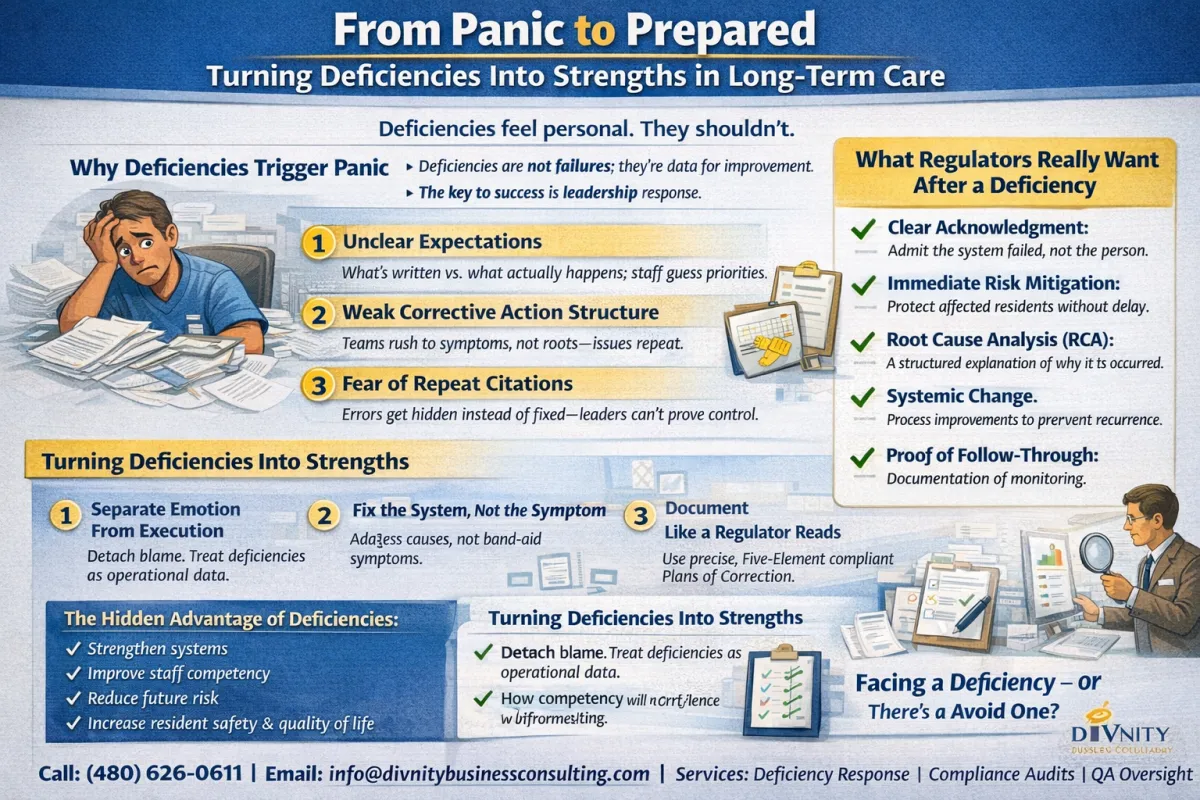
From Panic to Prepared: Turning LTC Deficiencies Into Strengths
Deficiencies feel personal. They shouldn’t.
For many long-term care leaders, an audit or survey announcement triggers the same reaction: a surge of anxiety and urgency. But a deficiency is not a verdict—it’s data.
Facilities that struggle treat deficiencies as failures.
Facilities that mature treat them as roadmaps for QAPI improvement.
The difference is not resources, staffing, or intent.
It is leadership response.
Organizations that thrive replace reactive audit fatigue with proactive audit readiness, embedding compliance into daily operations instead of scrambling when regulators arrive.
Why Deficiencies Trigger Panic
Most panic stems from three predictable breakdowns:
1. Unclear Expectations
A disconnect exists between what’s written in the Quality Management System (QMS) and what actually happens on the floor. Staff are left guessing which standard matters most.
2. Weak Corrective Action Structure
Without a defined response framework, teams rush to fix the symptom instead of the system—almost guaranteeing repeat citations.
3. Fear of Repeat Citations
In environments without psychological safety, staff hide errors instead of reporting them. That silence prevents learning and increases risk.
Regulators aren’t looking for perfection. They’re looking for control.
They want proof that your facility can identify, report, investigate, and correct issues before harm occurs.
What Regulators Actually Want After a Deficiency
When a deficiency is issued, surveyors immediately assess leadership oversight. A strong response demonstrates:
✔ Clear acknowledgment – An honest recognition that the system failed, regardless of intent
✔ Immediate risk mitigation – Protection of affected residents without delay
✔ Root Cause Analysis (RCA) – A structured explanation of why the failure occurred
✔ Systemic change – Process improvements that reduce recurrence
✔ Proof of follow-through – Documentation that the plan was implemented and monitored
Anything less signals a reactive organization.
Turning Deficiencies Into Strengths (The Right Way)
1. Separate Emotion From Execution
Deficiencies are operational, not personal. Emotional reactions lead to rushed plans—and rushed plans get rejected.
The Science:
Psychological safety is foundational to quality improvement. When staff fear blame, near-misses go unreported, blinding leadership to real risks.
The Action:
Detach emotionally. Treat deficiencies as learning data and build a fearless organization where transparency replaces defensiveness.
2. Fix the System, Not the Symptom
Most Plans of Correction fail because they focus on what happened, not why it happened.
Root Cause Discipline
Use structured tools (Five Whys, fishbone diagrams)
Resist jumping straight to solutions
Hierarchy of Actions
Weaker actions: reminders, re-training, policy updates
Stronger actions: forcing functions, workflow redesign, environmental controls
If staffing, training, or oversight caused the issue, that system must change.
Fixing the incident is a band-aid. Fixing the system is prevention.
3. Document the Correction Like a Regulator Reads
A Plan of Correction is not a narrative—it’s a regulatory commitment. Vague language equals weak confidence.
Every PoC must clearly address the Five Required Elements:
Corrective action for affected residents
Identification of others at risk
Systemic changes to prevent recurrence
Monitoring and auditing plan
Specific completion date
Surveyors reject PoCs that explain problems instead of proving control.
4. Train to the Deficiency
When staff behavior contributes to a deficiency, retraining must be precise and measurable.
What Surveyors Expect
Who will be trained
On exactly what content
How competency will be validated
Regulatory Alignment
Training must support QAPI (F941) and Compliance & Ethics (F946) requirements
Attendance sheets alone are not enough. Competency validation (return demonstration, case review) is what proves effectiveness.
5. Track and Prove Sustainability
Correcting an issue once is irrelevant unless you can prove it stays corrected.
Effective Sustainability Includes
Defined monitoring frequency (e.g., weekly x 4 weeks, then monthly)
Assigned accountability
QAA/QAPI committee review of trends
This is how a deficiency becomes evidence of leadership strength, not failure.
The Hidden Advantage of Deficiencies
Handled correctly, deficiencies can:
• Strengthen operational systems
• Improve staff competency and confidence
• Reduce future regulatory risk
• Increase leadership credibility
• Elevate resident safety and quality of life
Many high-performing facilities today became strong by learning early—and responding correctly.
How DiVnity Business Consulting Supports the Shift
Moving from audit fatigue to audit readiness requires structure, not guesswork. We support facilities through:
✔ Deficiency response strategy & RCA facilitation
✔ Regulator-aligned Plans of Correction (Five-Element compliant)
✔ System-level fixes that engineer safety into operations
✔ Post-correction monitoring that proves sustainability
So the next survey doesn’t repeat the same findings.
🚨 Facing a Deficiency—or Want to Avoid One?
The strategy is the same: prepare, don’t react.
📞 (480) 626-0611
📧 [email protected]
📋 Services: Deficiency Response | Compliance Audits | QA Oversight